


Lifts differ not only in load capacity and platform dimensions: different types of structures are designed for different operating conditions and areas of application. For example, some structures are designed for operation in unloading areas, while others are suitable for connecting several floors. Food production facilities, HoReCa establishments, parking facilities and public buildings also impose additional requirements.
Therefore, no configuration can generally be called the best overall, as the best lifts should be selected for specific types of business activities and operating conditions. And this is what a true TOP ranking of lifts for business should be.
In this ranking, we have collected ten types of lifts manufactured by FORSTOR that are well suited to different tasks. This TOP includes both universal warehouse models and specialized equipment. The selection takes into account load capacity, working height, installation specifics, the possibility of adapting the structure, operating conditions, etc.
1: Cantilever lift – a universal solution for warehouses
The cantilever lift tops our ranking as one of the most versatile configurations. This type of lifting equipment is effective for moving goods between the floors of a warehouse, store, archive or production facility.
Compared with a conventional freight elevator, a cantilever lift has a simpler and more compact design. It does not require a separate machine room, and installation does not necessarily require the construction of a permanent concrete shaft. The hydraulic power unit and distribution block can be placed next to the lift, so the equipment takes up less space and requires less construction and installation work.
The platform moves along a vertical column, while loading, depending on the configuration, can be organized from different sides. Another advantage of the cantilever structure is the possibility of adapting it to a specific facility. The manufacturer selects the platform dimensions, number of stops, position of gates, type of guarding and control system. The equipment can be designed for moving boxes, pallets, household appliances or industrial loads.
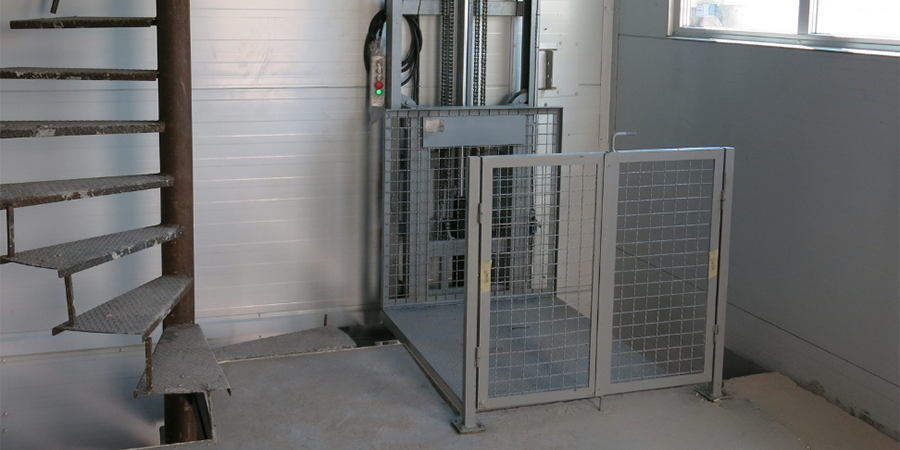
The main advantage of the cantilever design is its flexibility. The manufacturer selects the platform dimensions, number of stops, position of gates, type of guarding and control system according to the conditions at the facility. The lift can be designed for boxes, pallets, household appliances or industrial loads. For a warehouse where products are regularly moved between levels, this is one of the best and most common options.
2: Scissor lift – for heavy loads and unloading areas
A scissor lift table is used where a large platform and high load capacity are required. For example, at warehouse docks, production lines, goods receiving areas and vehicle unloading zones.
The platform rests on a system of crossed levers that open like scissors during lifting. The lift is installed directly on the floor or in a prepared pit. In the second case, the lowered platform is flush with the floor surface and does not interfere with the movement of warehouse equipment.
The equipment can include ramps, guardrails, gates, roller sections and roll-off stops. Are high load capacity and platform size the priority selection criteria? A lift table is the best choice for moving pallets, raw materials, machine tools, industrial assemblies and other heavy loads, as the load is evenly distributed over the entire surface of the structure.
3: Shaft lift – for connecting several floors
A shaft lift is designed for the regular movement of goods between two or more levels of a building. The enclosed structure separates the platform travel path and protects the openings between floors.
The FORSTOR team can install this equipment either in a new shaft or in an existing building shaft. A self-supporting metal structure can be installed inside the building or next to the facade. These options make it possible to equip even a building where a lift was not included in the original design.
A column or scissor system can be used inside the shaft. The column system performs better at greater heights, while the scissor system is suitable for large platforms and heavy loads. The specific configuration is determined after measuring the installation site and calculating the loads. Shaft models are often ordered for multi-storey warehouses, stores, service centers and industrial buildings.
4: Low-profile lift – installation without a pit
It is not possible to construct a pit at every facility. Obstacles can arise for various reasons. For example, due to the foundation structure, utilities installed in the floor, completed renovation work or the terms of the lease. In such cases, it is worth considering a low-profile lift, another popular type of lift included in this TOP 10.
This is a compact modification of a scissor lift table with a low height when fully lowered. It is installed directly on a concrete floor or asphalt, while the platform is equipped with a ramp to make access easier for a pallet truck or other warehouse equipment.
This type of installation requires less construction work and allows the equipment to be put into operation more quickly. Low-profile lift tables are used in warehouses, stores, production workshops and transshipment areas.
5: Two-column lift – for a large platform
A two-column lift is a reinforced version of the cantilever structure. Two columns increase platform stability and distribute the load evenly, which makes it possible to increase its dimensions and working load capacity. The lift can be installed inside a building or outdoors. Loading directions, gate positions and the number of stops are coordinated by the manufacturer with the company's logistics layout.
This type of lifting equipment is used for moving large batches of goods, containers, industrial machinery and loads with an offset center of gravity. A two-column structure is also appropriate when the platform size or load capacity reserve of a standard cantilever lift no longer meets the needs of the business.
6: Long-load lift – for pipes, logs and rolled metal products
Pipes, logs, sheet materials and long metal structures cannot be safely placed on a conventional short platform, so long-load scissor lifts are used for these applications.
The extended platform rests on several scissor sections that operate synchronously. This design distributes the weight evenly when moving long loads and maintains stability during movement.
Long-load lifts are installed at woodworking, metallurgical and machine-building enterprises, as well as at rolled metal warehouses. The platform dimensions, number of scissor sections and load capacity are calculated for specific products.
This is a specialized item in the ranking, but for handling long loads it is significantly better than attempting to adapt a standard lift table.
7: Stainless steel lift – for food and pharmaceutical facilities
In food production workshops, laboratories and pharmaceutical facilities, equipment operates under conditions of high humidity and regular sanitary cleaning. Under such conditions, conventional paint coatings are generally not used, and stainless steel is selected instead.
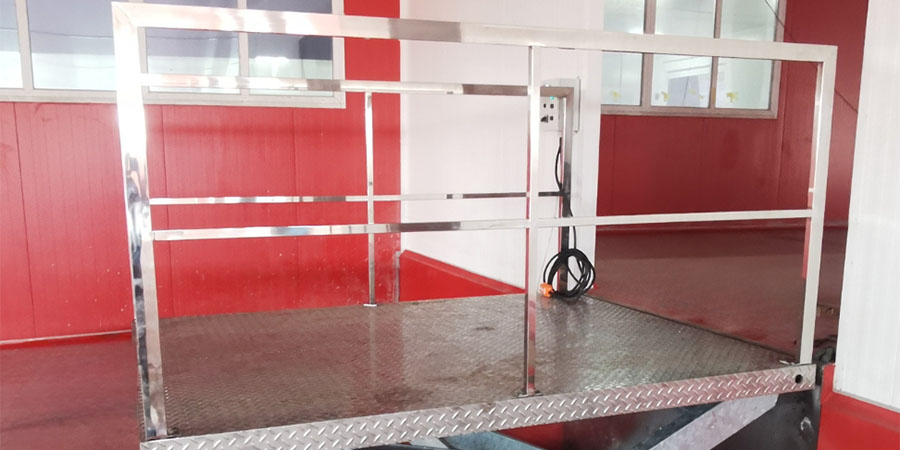
Stainless steel lifts have better resistance to corrosion and contact with cleaning agents. At the same time, either the entire structure or only the platform and the components that come into direct contact with the working environment can be made of stainless steel.
Before manufacturing this equipment, the temperature conditions, humidity level, cleaning method and composition of substances that will come into contact with the metal are taken into account. The choice of materials and the design of individual components depend on these factors.
8: Restaurant lift – compact equipment for horeca
A restaurant lift moves prepared meals, dishes, food products and small boxes between floors. It is most often installed in establishments where the kitchen, storage area and dining hall are located on different levels.
The cabin dimensions and the position of loading openings are determined according to the layout of the premises. Shelves for dishes or Gastronorm containers can be installed inside. Durable materials suitable for regular cleaning are used to manufacture the cabin. Restaurant models are also installed in hotels, bakeries, catering centers and even private houses.
9: Car lift – for garages and parking facilities
FORSTOR car and parking lifts are used to move vehicles between levels or to place two cars one above the other. This solution makes it possible to increase the capacity of a garage or parking facility without expanding its floor area.
Dependent systems can be installed without a pit, but the lower vehicle must be removed to access the upper platform. Independent structures with a pit allow each parking space to be used separately.
During the design process, the vehicle weight, wheelbase, overall height, load distribution and available space inside the facility are taken into account. Such lifts are ordered for residential complexes, business centers, car dealerships and private garages.
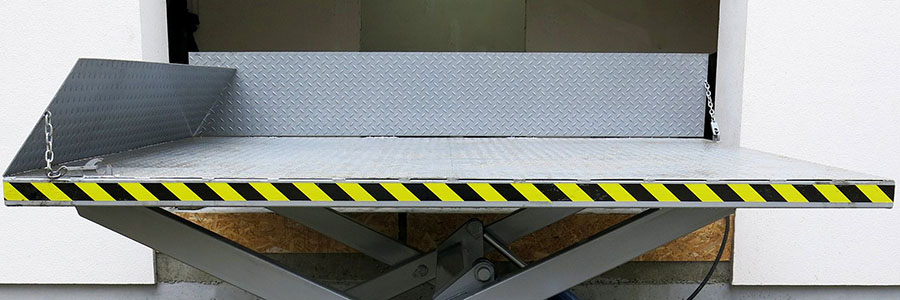
10: Stationary tail lift – for vehicle unloading
A stationary tail lift completes the ranking. It is compact transshipment equipment for warehouses, stores and goods receiving areas, used when the height of the vehicle body does not match the warehouse floor level.
The structure combines a scissor lifting mechanism and a folding bridge. The platform is raised to the level of the vehicle body, after which the folding section creates a transition between the vehicle and the unloading area.
Goods can be moved using a trolley or stacker without additional manual reloading. The tail lift can also be equipped with a ramp to provide convenient access for handling equipment. A stationary tail lift has a self-supporting structure and does not require the construction of a full-scale warehouse dock.
This FORSTOR solution is suitable for facilities that regularly receive vehicles with different body heights and require a compact stationary unloading area.
What information is required to select a lift?
Load capacity alone is not enough for calculation and design. Before contacting the manufacturer, it is worth preparing a list of the main load parameters and requirements for the lifting equipment:
- maximum load weight including the pallet, packaging or trolley
- dimensions and position of the center of gravity
- required platform dimensions
- lifting height and number of stops
- loading directions at each level
- installation location, indoors or outdoors
- temperature ranges, humidity and other operating conditions
- approximate number of operating cycles per shift
The more accurately the technical specification is prepared, the more accurate the design and cost estimate will be.
How to choose a lift manufacturer?
Evaluating a manufacturer based solely on the equipment price is risky. First, it is necessary to determine exactly what is included in the offer. One company may include the shaft, guardrails, door interlocks, delivery and installation, while another may quote only the cost of the basic platform.
A reliable manufacturer carries out measurements, calculates loads, develops drawings and provides technical documentation. Before work begins, it is also worth clarifying the installation conditions, warranty period, service procedure and availability of spare parts.
It is useful to review completed projects with similar parameters. They show better than a general ranking whether the manufacturer has experience working with the required type of equipment.
Which lift is better?
For most warehouses, the cantilever lift remains a universal solution. In transshipment areas and when working with heavy loads, scissor lift tables perform better. For several floors, it is advisable to consider a shaft structure, while a low-profile model is suitable when it is not possible to construct a pit.
The remaining positions in the TOP are intended for more specialized tasks: long products, food production, restaurants, parking facilities and vehicle unloading. The final type of lift can only be determined after measuring the facility and approving the technical specification.
The FORSTOR factory designs and manufactures lifts according to individual parameters and provides delivery, installation and commissioning. For a preliminary calculation, it is necessary to provide information about the load, lifting height, number of stops and operating conditions.